Track Details
Ne Rien Faire
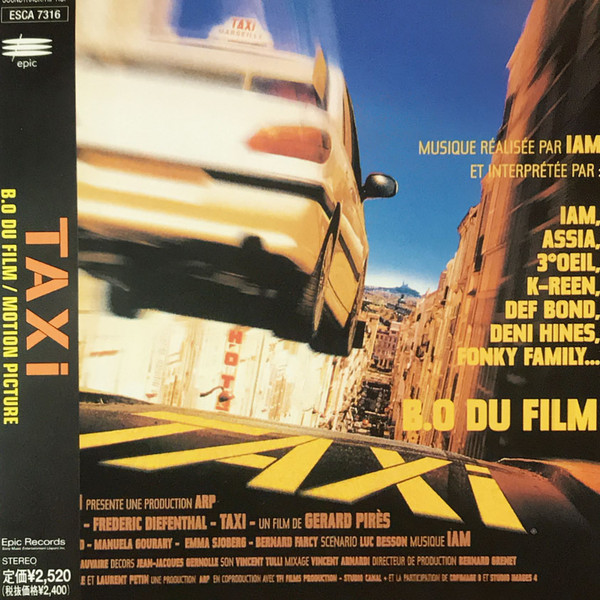
Karl – “Ne Rien Faire” is one of the lesser-known gems from the Taxi soundtrack, released in 1998. Surrounded by some of the defining names of late-1990s French hip-hop, the track has gradually become a fascinating piece of soundtrack history — especially for listeners returning to the music of the original Taxi movie more than two decades later.
Karl – “Ne Rien Faire” and the 1998 Taxi Soundtrack
“Ne Rien Faire” appeared on the soundtrack to the original Taxi, the 1998 French action comedy directed by Gérard Pirès and produced and written by Luc Besson.
The soundtrack was deeply connected with the French hip-hop scene of the period, particularly Marseille. Its tracklist included artists such as IAM, Akhenaton, Fonky Family, 3ème Œil, Freeman, K-Rhyme Le Roi, Carré Rouge, Mafia Underground, K-Reen and Def Bond.
Karl's “Ne Rien Faire” appears as track number 10 on the album, running for approximately four minutes and nineteen seconds.
A Forgotten Piece of French Hip-Hop History
Compared with artists such as IAM or Fonky Family, surprisingly little documented information about Karl has survived online. That relative mystery is one of the reasons “Ne Rien Faire” remains such an interesting track today.
It feels like a musical snapshot preserved inside the Taxi soundtrack: a recording strongly rooted in the sound and atmosphere of late-1990s French rap, yet one whose story was never extensively documented in interviews, retrospectives or modern streaming-era promotional material.
For listeners who first encountered it through the film or soundtrack, rediscovering the track today can feel like opening a small time capsule from 1998.
The Sound of “Ne Rien Faire”
Musically, “Ne Rien Faire” belongs to the sample-driven aesthetic that characterised much of 1990s hip-hop. Rather than relying on an aggressive or heavily polished production style, the track works through atmosphere, groove and repetition.
Its understated production leaves plenty of space around the vocal, giving the record the warm and slightly dusty texture associated with classic boom-bap and French rap production of the era.
This restrained approach is particularly effective within the wider Taxi soundtrack. The movie may be remembered for speed, Marseille streets, tuned Peugeot taxis and frantic police chases, but much of its accompanying music explored a darker, slower and more reflective side of the city's culture.
How Was Karl's “Ne Rien Faire” Recorded?
Detailed information about the actual recording sessions for “Ne Rien Faire” is difficult to find. There are no widely available contemporary interviews documenting the studio, recording equipment, sampler or exact production process used to create the track.
That is not particularly unusual for a soundtrack cut released in 1998. The song comes from an era before studio sessions were routinely photographed, filmed and archived online, and many recordings from the period survive with little more documentation than the original record credits.
Rather than inventing a studio story that cannot be verified, the record itself remains the best evidence of the production philosophy behind it: minimal arrangement, sample-oriented construction and a groove designed primarily to support the vocal.
Why the Taxi Soundtrack Was Important
The original Taxi soundtrack was more than background music for a successful French film. It captured a moment when Marseille hip-hop was becoming increasingly visible to a national audience.
IAM and artists from the surrounding Marseille scene had already helped establish a distinctive alternative to American rap. French-language lyricism, cinematic samples, soul and funk influences and a strong sense of local identity all contributed to a recognisable Marseille sound.
Taxi brought that culture into mainstream cinema. As a result, listening to the soundtrack today also means hearing a document of French hip-hop at the end of the 1990s.
“Ne Rien Faire”: The Meaning of the Title
The French expression ne rien faire literally means “to do nothing.”
There is an amusing contrast between that title and the film that introduced the track to many listeners. Few movies could be further removed from the concept of doing nothing than Taxi, a film built around high-speed driving, police pursuits and Daniel's famously modified Peugeot.
Yet that contrast illustrates something interesting about the soundtrack. Its music was never limited to simply imitating the speed and action of the movie. Instead, it presented a much wider picture of the musical culture surrounding Marseille at the time.
Where “Ne Rien Faire” Sits on the Taxi OST
Karl's track appears among several songs that became closely associated with the first Taxi film.
- Chiens de Paille – “Maudits Soient Les Yeux Fermés”
- Assia – “Dini”
- Fonky Family – “L'Amour du Risque”
- 3ème Œil – “La Vie de Rêve”
- Freeman & K-Rhyme Le Roi – “Le Dernier Coup”
- Karl – “Ne Rien Faire”
- IAM – “Marseille la Nuit”
- Mafia Underground – “Taxi”
- Carré Rouge – “Vie Infecte”
- Akhenaton – “Lyrix Files”
In this company, “Ne Rien Faire” was never the obvious headline track. That arguably makes its survival even more interesting: decades later, people continue searching for the song after rediscovering the original Taxi soundtrack.
Rediscovering Karl – “Ne Rien Faire” Today
More than twenty-five years after the release of Taxi, “Ne Rien Faire” still carries the unmistakable atmosphere of late-1990s French hip-hop.
There was no social-media campaign surrounding the track, no endless collection of studio clips and no algorithmically optimised release strategy. For many listeners, the song simply existed on a soundtrack CD — waiting to be encountered somewhere between better-known names.
That anonymity has arguably helped it age well. Instead of being inseparable from a huge promotional campaign, the track survives primarily through the music itself and through listeners who remember discovering it in Taxi.
For fans of classic French hip-hop, forgotten soundtrack cuts and the distinctive musical world of late-1990s Marseille, Karl – “Ne Rien Faire” remains a track worth rediscovering.
About karl
The Scorpions are a German hard rock/heavy metal band formed in Hanover in 1965 by guitarist Rudolf Schenker. The longest-running and most successful line-up of the band included Schenker, Klaus Meine (vocals), Matthias Jabs (lead guitar), Francis Buchholz (bass), and Herman Rarebell (drums), and lasted from 1978 to 1992. The band's only continuous member has been Schenker, although Meine has been with the band continuously since 1969, while Jabs has been a consistent member since 1978 and bassist Paweł Mąciwoda and drummer Mikkey Dee have been in the band since 2003 and 2016, respectively. The band's debut album, Lonesome Crow (1972), featured Schenker's younger brother Michael on lead guitar, before he departed to join UFO. He was replaced by Uli Jon Roth, who played with the band on their next four studio albums, Fly to the Rainbow (1974), In Trance (1975), Virgin Killer (1976) and Taken by Force (1977), and their first live album Tokyo Tapes (1978). Following Roth's departure, the band recruited Matthias Jabs and began moving towards a more melodic rock style on their sixth studio album Lovedrive (1979), which also saw the Scorpions reunite briefly with Michael Schenker before he left again to begin a solo career. Over the next decade, the band achieved influence, approval from music critics, and significant commercial success with the albums Animal Magnetism (1980), Blackout (1982), Love at First Sting (1984), the live album World Wide Live (1985), Savage Amusement (1988), the compilation album Best of Rockers 'n' Ballads (1989) and Crazy World (1990), all of which are certified at least platinum in the United States. The band has released thirteen consecutive studio albums that were in the top 10 in Germany, one of which reached No. 1, as well as three consecutive albums that were in the top 10 in the Billboard 200 in the United States. Their latest studio album, Rock Believer, was released in February 2022. The Scorpions are estimated to have sold over 100 million records worldwide, making them one of the best-selling hard rock and heavy metal bands of all time. One of their most recognized hits is "Wind of Change" (from Crazy World), a symbolic anthem of the political changes in Eastern Europe in the late 1980s and early 1990s and the fall of the Berlin Wall, and it remains as one of the best-selling singles in the world with over 14 million copies. Two songs from their ninth studio album Love at First Sting, "Rock You Like a Hurricane" and "Still Loving You", are regarded as some of the most influential and popular works, both in heavy metal music and among rock ballads, defined as "rock anthem" and "a true hymn of love", respectively.
Discussion
No comments yet. Be the first to share your thoughts!
No comments yet.